
Tech Events & Workshops
Discover and join virtual tech events, workshops, and meetups from the Ubuntu community worldwide. Connect with developers, engineers, and tech enthusiasts.
Today
Upcoming
Virtual
Total

From Idea to Live Web App: Building with Humans and AI Agents on Buzz
## What to Expect AI assistants can help one person write code. The more interesting question is what happens when humans and AI agents work together on a real product, with the conversation, decisions, reviews, and work kept in one shared place. Join The Ubuntu TechHive for a beginner-friendly live build using Buzz, an open-source workspace designed for humans and AI agents to collaborate. We will start with a real but deliberately incomplete product brief, work through research, design, implementation, and review, and finish by deploying a working web application that you can open in your browser. The application will be revealed during the session. This gives the community room to follow the work as it develops, contribute ideas, and see how a small team can move from an uncertain starting point to a useful deployed result. The focus is not only the application itself, but the collaboration process that makes the build understandable, reviewable, and repeatable. No prior Buzz, Nostr, or AI-agent experience is required. You will be invited to join the Ubuntu TechHive Buzz community, follow the build channel, ask questions, inspect the human-and-agent work trail, and continue the conversation with supporting material after the event. ## What We’ll Build Together - Start from an incomplete product idea and clarify what is worth building. - Use Buzz as the shared room for human decisions, agent research, implementation, and review. - Turn the selected direction into a browser-based web application. - Deploy the result to a public URL during the session. - Test the deployed application and discuss what should happen next. The exact application, framework, and feature list will be revealed as the build unfolds. That is part of the event: the audience gets to see the product take shape instead of watching a finished demo with all of the uncertainty removed. ## Agenda - Introduction: From individual AI assistants to teams of humans and agents building together. - Getting oriented: What Buzz is, how to join the community, and how channels, identities, agents, and project history work. - The live build: Open the brief, explore the problem, delegate work, make design decisions, implement the web application, and review the result in Buzz. - Deployment: Publish the working application to a public web URL and test it live with the audience. - What happened behind the scenes: Trace the useful decisions, rejected ideas, agent contributions, and human approvals in the Buzz channel. - Keep building with us: Join the community, read the supporting article, try the deployed result, and suggest the next improvement. - Questions and answers: Discuss Buzz, agent collaboration, web development, open-source workflows, and the live build. ## Who Should Attend? - Developers and learners curious about AI-assisted web development. - People who use AI coding tools but want to understand collaboration with multiple agents and human teammates. - Open-source developers interested in building in public and self-hostable tools. - Community members who enjoy seeing real software take shape through a live demonstration. - Beginners who want to learn what Buzz is by watching it solve a concrete problem. ## What You’ll Learn - Explain what Buzz is without prior knowledge of the platform. - Understand how human and agent identities can share a project workspace while keeping authorship and responsibility clear. - See a practical workflow for turning an incomplete brief into a reviewed web application. - Recognize how channels, history, search, and agent identity support better collaboration. - Join the [Ubuntu TechHive community on Buzz](https://ubuntu-techhive.communities.buzz.xyz/invite/v2.ipzGEj2p4HjIwM07OxfhZ_D-5A_38st6LP231xwUT6c) and find the live build and community-projects channels. - Evaluate where this approach could be useful in your own projects.
View EventFrom Idea to Live Web App: Building with Humans and AI Agents on Buzz
## What to Expect AI assistants can help one person write code. The more interesting question is what happens when humans and AI agents work together on a real product, with the conversation, decisions, reviews, and work kept in one shared place. Join The Ubuntu TechHive for a beginner-friendly live build using Buzz, an open-source workspace designed for humans and AI agents to collaborate. We will start with a real but deliberately incomplete product brief, work through research, design, implementation, and review, and finish by deploying a working web application that you can open in your browser. The application will be revealed during the session. This gives the community room to follow the work as it develops, contribute ideas, and see how a small team can move from an uncertain starting point to a useful deployed result. The focus is not only the application itself, but the collaboration process that makes the build understandable, reviewable, and repeatable. No prior Buzz, Nostr, or AI-agent experience is required. You will be invited to join the Ubuntu TechHive Buzz community, follow the build channel, ask questions, inspect the human-and-agent work trail, and continue the conversation with supporting material after the event. ## What We’ll Build Together - Start from an incomplete product idea and clarify what is worth building. - Use Buzz as the shared room for human decisions, agent research, implementation, and review. - Turn the selected direction into a browser-based web application. - Deploy the result to a public URL during the session. - Test the deployed application and discuss what should happen next. The exact application, framework, and feature list will be revealed as the build unfolds. That is part of the event: the audience gets to see the product take shape instead of watching a finished demo with all of the uncertainty removed. ## Agenda - Introduction: From individual AI assistants to teams of humans and agents building together. - Getting oriented: What Buzz is, how to join the community, and how channels, identities, agents, and project history work. - The live build: Open the brief, explore the problem, delegate work, make design decisions, implement the web application, and review the result in Buzz. - Deployment: Publish the working application to a public web URL and test it live with the audience. - What happened behind the scenes: Trace the useful decisions, rejected ideas, agent contributions, and human approvals in the Buzz channel. - Keep building with us: Join the community, read the supporting article, try the deployed result, and suggest the next improvement. - Questions and answers: Discuss Buzz, agent collaboration, web development, open-source workflows, and the live build. ## Who Should Attend? - Developers and learners curious about AI-assisted web development. - People who use AI coding tools but want to understand collaboration with multiple agents and human teammates. - Open-source developers interested in building in public and self-hostable tools. - Community members who enjoy seeing real software take shape through a live demonstration. - Beginners who want to learn what Buzz is by watching it solve a concrete problem. ## What You’ll Learn - Explain what Buzz is without prior knowledge of the platform. - Understand how human and agent identities can share a project workspace while keeping authorship and responsibility clear. - See a practical workflow for turning an incomplete brief into a reviewed web application. - Recognize how channels, history, search, and agent identity support better collaboration. - Join the [Ubuntu TechHive community on Buzz](https://ubuntu-techhive.communities.buzz.xyz/invite/v2.ipzGEj2p4HjIwM07OxfhZ_D-5A_38st6LP231xwUT6c) and find the live build and community-projects channels. - Evaluate where this approach could be useful in your own projects.
View Event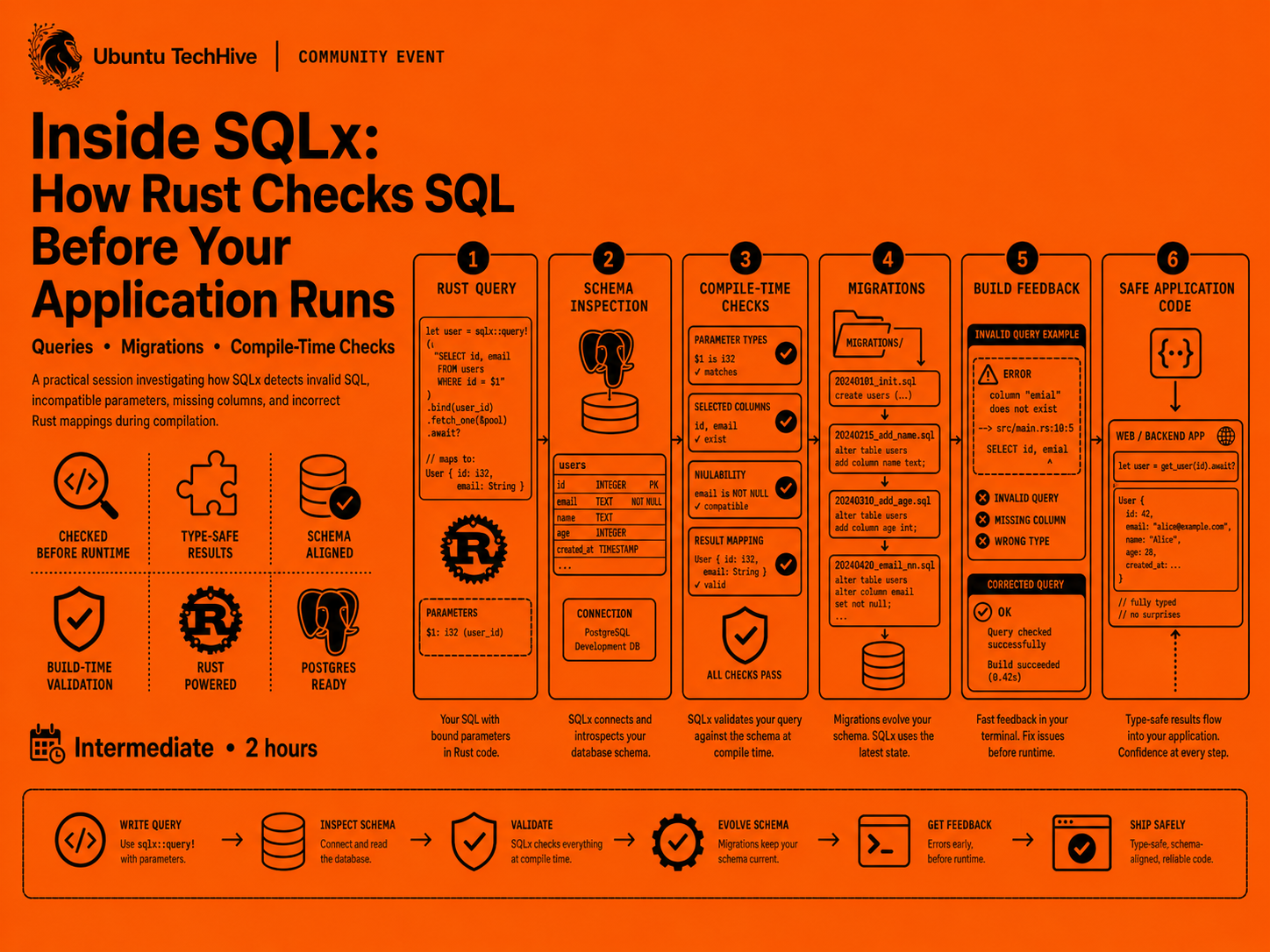
Inside SQLx: How Rust Checks SQL Before Your Application Runs
A practical two-hour session investigating how SQLx can detect invalid SQL, incompatible parameters, missing columns, and incorrect Rust mappings during compilation rather than after deployment. The session follows a query through the boundary between Rust and the database: from the SQL text and bound parameters, through schema inspection and type analysis, to the Rust value returned to the application. We will deliberately break queries, change schemas, and introduce type mismatches to understand what SQLx can prove before runtime—and what it cannot. The emphasis is not on memorizing an API. It is on understanding the engineering model behind compile-time checked SQL, the role of migrations in preserving that model, and the practical consequences for local development, testing, continuous integration, and deployment. Audience: developers who want to understand how Rust can provide stronger guarantees around ordinary SQL without replacing SQL with an ORM or query language. Outcomes: * Trace how SQLx validates a query during compilation * Understand how database metadata informs Rust type checking * See compile-time failures caused by invalid queries and incompatible result types * Understand why the current schema matters during a build * Connect database migrations to query correctness * Distinguish checked macros from runtime query APIs * Evaluate when compile-time SQL checking improves a project and when it adds friction Format: two hours with a guided investigation, broken-query experiments, migration examples, discussion of operational tradeoffs, and a reusable checklist for database code.
View EventInside SQLx: How Rust Checks SQL Before Your Application Runs

Maîtriser les outils d'intelligence artificielle pour créer, promouvoir et monétiser

Building Document Question-Answering Systems with Rust
Building Document Question-Answering Systems with Rust

Rust Data Pipelines: From Files to Clean Databases and Web Dashboards
Rust Data Pipelines: From Files to Clean Databases and Web Dashboards

De consommateur à créateur : prenez une longueur d’avance avec l’Intelligence Artificielle !

Rust Data Processing with Polars: CSV, Parquet, Joins, and Lazy Queries