
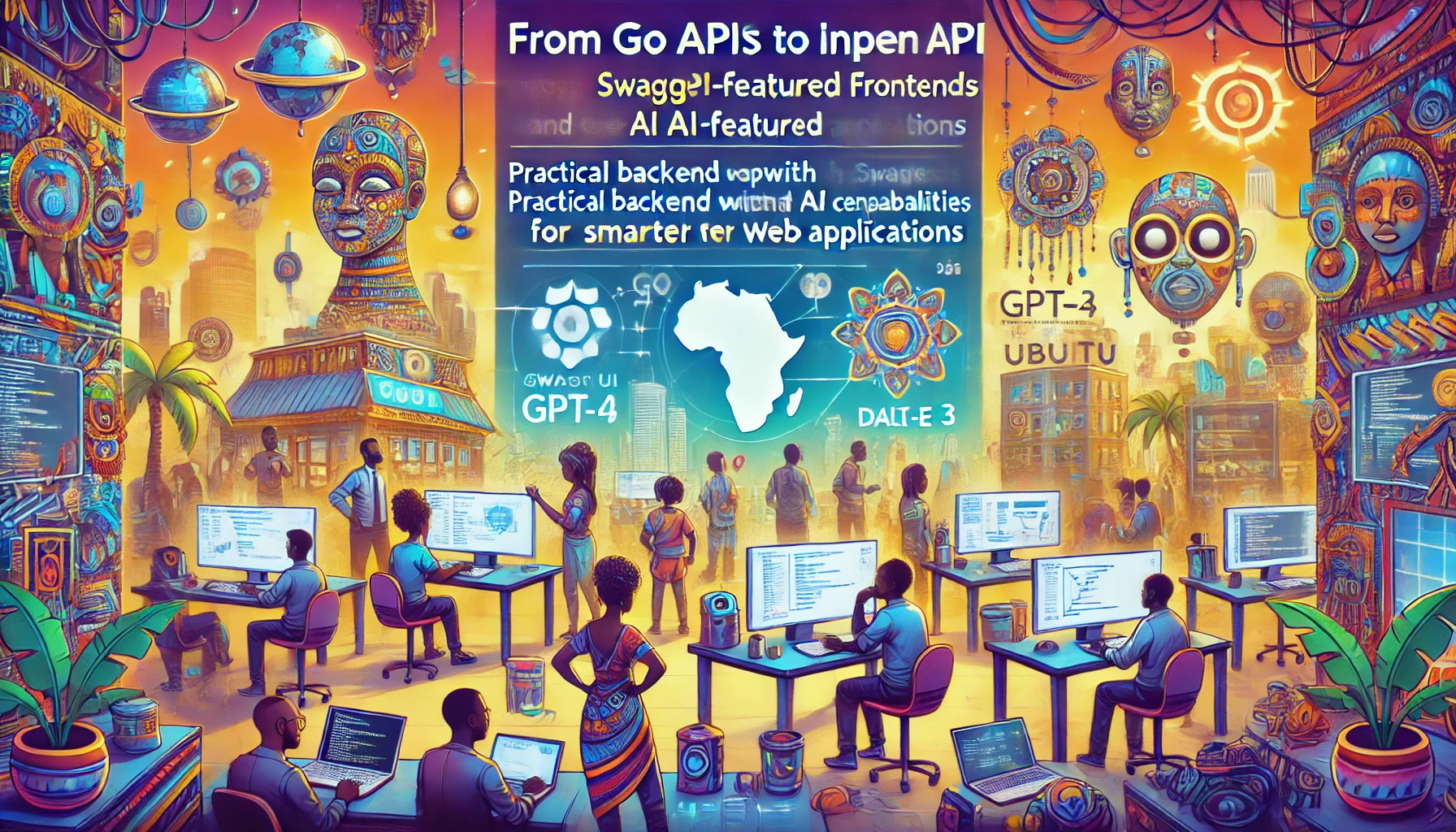
From Go APIs to AI-Featured Frontends
- Building Modern APIs with Go, OpenAPI, and CUE
- The Go net/http Package
- Parsing JSON with the GJSON Package
- Demo 1: Interact with OpenAI's gpt-4o API from Go
- CUE Language (Configure Unify Execute)
- Demo 2: Basic API with Go and Cue
- Demo 3: Swagger UI
- Demo 4: Image Information Retrieval
- Demo 5: Triple Streaming
- References
Building Modern APIs with Go, OpenAPI, and CUE
Introduction
In this course, we'll explore the powerful combination of Go, OpenAPI, and CUE to build robust, type-safe, and well-documented APIs. This modern approach leverages the strengths of each technology to create maintainable and validated API implementations.
Core Technologies
Go Programming Language
Go provides an excellent foundation for building web services with its:
- Strong standard library
- Built-in concurrency
- Excellent performance characteristics
- Clear and maintainable syntax
- Rich ecosystem of tools and packages
Go's HTTP Package
The net/http package serves as both:
Server-side
- Native HTTP server implementation
- Request routing and handling
- Middleware support
- Response writing utilities
Client-side
- HTTP client operations
- Request composition
- Response handling
- Connection pooling
CUE Language
CUE (Configure, Unify, Execute) brings several crucial capabilities:
Schema Definition
- Type-safe definitions
- Constraint specifications
- Composition and inheritance
- Default values
JSON Schema Generation
- OpenAPI 3.0 schema generation
- Type validation
- Documentation generation
- Contract enforcement
Runtime Validation
- Request/response validation
- Data consistency checks
- Error messaging
- Type assertions
Objectives
- Design APIs using OpenAPI 3.0 specifications
- Define schemas using CUE's powerful constraint system
- Generate OpenAPI documentation from CUE definitions
- Implement APIs using Go's standard library
- Validate requests and responses using CUE
- Create maintainable and type-safe API implementations
Why This Combination?
Type Safety
- Go's static typing
- CUE's constraint system
- OpenAPI's schema definitions
Developer Experience
- Clear separation of concerns
- Automated validation
- Self-documenting APIs
- Tool-friendly formats
Maintenance Benefits
- Single source of truth for types
- Automated schema generation
- Runtime validation
- Clear contract definitions
Tooling Installation Guide
Setting Up Development Environment
Installing Goenv
macOS (using Homebrew)
brew install goenvLinux/Unix
git clone https://github.com/go-nv/goenv.git ~/.goenvConfigure Shell (add to ~/.bashrc or ~/.zshrc)
export GOENV_ROOT="$HOME/.goenv"
export PATH="$GOENV_ROOT/bin:$PATH"
eval "$(goenv init -)"
Installing Go using Goenv
List available versions
goenv install --listInstall latest stable version
goenv install 1.23.3Set global Go version
goenv global 1.23.3Verify installation
go versionInstalling CUE
Using Go install
go install cuelang.org/go/cmd/cue@latestVerify CUE installation
cue versionThe Go net/http Package
The Go `net/http` package provides HTTP client and server implementations. It's used for making API calls and building web servers.
Key Features
- Support for HTTP/1.1, HTTP2
- TLS (HTTPS) support
- HTTP client and server abstraction
- Routing support via `http.ServeMux`
HTTP Client
The `http.Client` type is used to perform HTTP requests.
Creating an HTTP GET Request
package main

import (
    "fmt"
    "io"
    "net/http"
)

func main() {
    resp, err := http.Get("https://api.example.com/data")
    if err != nil {
        fmt.Println("Error:", err)
        return
    }
    defer resp.Body.Close()

    body, err := io.ReadAll(resp.Body)
    if err != nil {
        fmt.Println("Error reading response body:", err)
        return
    }

    fmt.Println("Response Body:", string(body))
}
Creating an HTTP POST Request
package main

import (
    "bytes"
    "fmt"
    "net/http"
)

func main() {
    jsonData := []byte(`{"key": "value"}`)
    resp, err := http.Post("https://api.example.com/data", "application/json", bytes.NewBuffer(jsonData))
    if err != nil {
        fmt.Println("Error:", err)
        return
    }
    defer resp.Body.Close()

    fmt.Println("Response Status:", resp.Status)
}
HTTP Server
The `http.Server` type is used to implement HTTP servers.
Basic HTTP Server
package main

import (
    "fmt"
    "net/http"
)

func helloHandler(w http.ResponseWriter, r *http.Request) {
    fmt.Fprintf(w, "Hello, World!")
}

func main() {
    http.HandleFunc("/hello", helloHandler)
    http.ListenAndServe(":8080", nil)
}
Using http.ServeMux for Routing
package main

import (
    "fmt"
    "net/http"
)

func helloHandler(w http.ResponseWriter, r *http.Request) {
    fmt.Fprintf(w, "Hello, World!")
}

func main() {
    mux := http.NewServeMux()
    mux.HandleFunc("/hello", helloHandler)

    server := &http.Server{
        Addr:    ":8080",
        Handler: mux,
    }

    server.ListenAndServe()
}
Http package documentation
Parsing JSON with the GJSON Package
Overview
- Fast JSON parser for Go
- Uses path syntax to extract values from JSON
- No serialization/deserialization required
- Zero dependencies
- Thread-safe
Key Features
Path Syntax
{"name": {"first": "John"}}
// Access with: "name.first" -> "John"
Supported Types
- Strings
- Numbers
- Booleans
- Null
- Arrays
- Objects
Performance
- Very fast parsing
- No allocation overhead
- Operates directly on []byte
Common Operations
value := gjson.Get(json, "path.to.value")
value.String()  // Get as string
value.Int()     // Get as integer
value.Array()   // Get as array
value.Map()     // Get as map
Modifiers
- @reverse: Reverse array
- @flatten: Flatten array
- @join: Join array elements
- @valid: Validate JSON
Use Cases
- API responses parsing
- Configuration handling
- JSON data extraction
- Performance-critical JSON operations
GJSON Documentation Links
GitHub Repository
GoDoc Documentation
Demo 1: Interact with OpenAI's gpt-4o API from Go
var (
    apiURL = "https://api.openai.com/v1/chat/completions" // replace with actual endpoint
    apiKey = os.Getenv("OPENAI_API_KEY")
    imagePath = "assets/from-go-apis-to-ai-enhanced-frontends.webp"
    prompt = "Describe the scenery in the image."
)

fmt.Println(fmt.Sprintf("Extracting Info from: %v\n", imagePath))
// Load image and encode as base64
imageBytes, err := os.ReadFile(imagePath)
if err != nil {
    fmt.Println("Error reading image file:", err)
    return
}
imageBase64 := base64.StdEncoding.EncodeToString(imageBytes)

requestBody, err := json.Marshal(map[string]any{
	"model":      "gpt-4o",
    "max_tokens": 4096,
    "messages": []map[string]any{
		{
			"role": "user",
			"content": []map[string]any{
				{
					"type": "text",
					"text": prompt,
				},
				{
					"type": "image_url",
					"image_url": map[string]any{
						"url": fmt.Sprintf("data:image/webp;base64, %s", imageBase64),
					},
				},
			},
		},
	},
})
if err != nil {
	fmt.Println("Error marshalling JSON:", err)
	return
}

req, err := http.NewRequest("POST", apiURL, bytes.NewBuffer(requestBody))
if err != nil {
	fmt.Println("Error creating request:", err)
	return
}
req.Header.Set("Authorization", "Bearer "+apiKey)
req.Header.Set("Content-Type", "application/json")

client := &http.Client{}
resp, err := client.Do(req)
if err != nil {
    fmt.Println("Error making request:", err)
    return
}
defer resp.Body.Close()

body, err := io.ReadAll(resp.Body)
if err != nil {
    fmt.Println("Error reading response body:", err)
    return
}

responseString := string(body)
// fmt.Println("Response:", responseString)

result := gjson.Get(responseString, "choices.0.message.content")

fmt.Println(result.Str)
CUE Language (Configure Unify Execute)
Overview
CUE is a configuration and constraint language created by Google to help manage complex configurations and data validation.
Core Concepts
Data Model
- Open-world model
- Inheritance and composition
- Strongly typed
- Declarative
Key Features
Type Constraints
#Person: {
    name:  string
    age:   int & >=0 & <=120
    email: string & =~"^[a-zA-Z0-9._%+-]+@[a-zA-Z0-9.-]+\\.[a-zA-Z]{2,}$"
}
Value Constraints
settings: {
    timeout: int & >=0 & <=60
    mode:    "dev" | "prod" | "stage"
}
Integration with Go
Go Struct Tags
type Person struct {
    Name  string `json:"name" cue:"string"`
    Age   int    `json:"age" cue:">=0 & <=120"`
    Email string `json:"email"`
}
Validation Example
import "cuelang.org/go/cue"

const schema = `
#Person: {
    name:  string
    age:   int & >=0
    email: string
}
`

func validate(data interface{}) error {
    ctx := cue.context.New()
    v := ctx.CompileString(schema)
    return v.Validate()
}
Common Use Cases
Configuration Management
#Database: {
    host:     string
    port:     int & >=1024 & <=65535
    user:     string
    password: string
}

prod: #Database & {
    host: "prod.db.example.com"
    port: 5432
    user: "admin"
}
Data Validation
#APIConfig: {
    endpoints: [...{
        path:   string & =~"^/"
        method: "GET" | "POST" | "PUT" | "DELETE"
        auth:   bool | *true
    }]
}
OpenAPI Generation
openapi: "3.0.0"
info: {
    title:   "My API"
    version: "1.0.0"
}
Tooling
Command Line
- cue eval
- cue fmt
- cue vet
- cue export
IDE Support
- VSCode extension
- GoLand/IntelliJ plugin
Best Practices
Schema Definition
- Use # prefix for definitions
- Keep constraints simple and clear
- Use meaningful names
Error Handling
if err := val.Validate(); err != nil {
    return fmt.Errorf("validation failed: %w", err)
}
Resources
Official Documentation
Learning Resources
- Official tutorials
- GitHub examples
- Community guides
Common Patterns
Default Values
#Config: {
    debug: bool | *false
    port:  int | *8080
}
Composition
#Base: {
    version: string
}

#Service: #Base & {
    name:  string
    ports: [...int]
}
Relationship with Go
Integration Points
- Direct Go API
- Struct tag support
- Code generation
- Runtime validation
Benefits
- Type safety
- Schema validation
- Configuration management
- Data modeling
Use Cases
- API definitions
- Configuration files
- Data validation
- Schema generation
Error Messages
invalid value "foo" (does not match ">=0 & <=120")
conflicting values false and true
field "required" not allowed
CUE Language Documentation Links
Official Resources
- Main Website: https://cuelang.org/
- Official Documentation: https://cuelang.org/docs/
- API Reference: https://pkg.go.dev/cuelang.org/go/cue
GitHub Resources
- Main Repository: https://github.com/cue-lang/cue
- CUE Playground: https://cuelang.org/play/
Learning Resources
- Reference Guide: https://cuelang.org/docs/references/
- Specification: https://cuelang.org/docs/references/spec/
Demo 2: Basic API with Go and Cue
The Entities
#User: {
    id:   string
    name: string & =~"^[A-Za-z ]+$"
}
Entities as JSON / Yaml Schema:
rm -rf contracts/basic_schema.yaml # delete if already exists

cue def contracts/user.cue -o contracts/basic_schema.yaml --out openapi+yaml # generate schema

cat contracts/basic_schema.yaml # show the contents of the resulting file
openapi: 3.0.0
info:
  title: Generated by cue.
  version: no version
paths: {}
components:
  schemas:
    User:
      type: object
      required:
        - id
        - name
      properties:
        id:
          type: string
        name:
          type: string
          pattern: ^[A-Za-z ]+$
The OpenAPI Contract:
Improving on the previous output, we manually include the `paths` definition.
# basic_schema.yaml
openapi: 3.0.0
info:
  title: User API
  version: 1.0.0
paths:
  /users:
    post:
      summary: Create user
      requestBody:
        required: true
        content:
          application/json:
            schema:
              $ref: '#/components/schemas/User'
      responses:
        '200':
          description: User created
          content:
            application/json:
              schema:
                $ref: '#/components/schemas/User'
components:
  schemas:
    User:
      type: object
      required:
        - id
        - name
      properties:
        id:
          type: string
        name:
          type: string
          pattern: ^[A-Za-z ]+$
The server:
package main

// basic_cueapi.go

import (
	"encoding/json"
	"fmt"
	"log"
	"net/http"

	"cuelang.org/go/cue"
	"cuelang.org/go/cue/cuecontext"
)

type User struct {
	ID   string `json:"id"`
	Name string `json:"name"`
}

const schema = `
#User: {
    id:   string
    name: string & =~"^[A-Za-z ]+$"
}
`

var ctx = cuecontext.New()
var userSchema = ctx.CompileString(schema)

func validateUser(u User) error {
	val := ctx.Encode(u)
	return val.Unify(userSchema.LookupPath(cue.ParsePath("#User"))).Err()
}

func userHandler(w http.ResponseWriter, r *http.Request) {

	var user User
	if err := json.NewDecoder(r.Body).Decode(&user); err != nil {
		http.Error(w, err.Error(), http.StatusBadRequest)
		return
	}

	if err := validateUser(user); err != nil {
		fmt.Println(fmt.Errorf("INVALID_PAYLOAD:::: +%v", err))
		http.Error(w, err.Error(), http.StatusBadRequest)
		return
	}

	w.Header().Set("Content-Type", "application/json")
	json.NewEncoder(w).Encode(user)
}

func main() {
	http.HandleFunc("POST /users", userHandler)
	log.Fatal(http.ListenAndServe(":8080", nil))
}
Let's test this basic API:
echo "Happy Path Scenario Result:"
echo ""
curl -X POST localhost:8080/users -d '{"id":"1","name":"John Doe"}' # happy path test

echo ""
echo ""

echo "Fail Validation Scenario Result:"
echo ""
curl -X POST localhost:8080/users -d '{"id":"1","name":"1234"}' # fail the schema validation
Happy Path Scenario Result:

{"id":"1","name":"John Doe"}


Fail Validation Scenario Result:

name: invalid value "1234" (out of bound =~"^[A-Za-z ]+$")
Demo 3: Swagger UI
Yaml to JSON conversion
mkdir -p demos/demo3

go run cli.go y2j contracts/demo2.yaml demos/demo3/openapi.json
Successfully converted contracts/demo2.yaml to demos/demo3/openapi.json
Updated Server
package main

import (
	"embed"
	"encoding/json"
	"fmt"
    "html/template"
	"log"
	"net/http"

	"cuelang.org/go/cue"
	"cuelang.org/go/cue/cuecontext"
)


//go:embed *
var content embed.FS

type User struct {
	ID   string `json:"id"`
	Name string `json:"name"`
}

const schema = `
#User: {
    id:   string
    name: string & =~"^[A-Za-z ]+$"
}
`

var ctx = cuecontext.New()
var userSchema = ctx.CompileString(schema)

func validateUser(u User) error {
	val := ctx.Encode(u)
	return val.Unify(userSchema.LookupPath(cue.ParsePath("#User"))).Err()
}

func userHandler(w http.ResponseWriter, r *http.Request) {

	var user User
	if err := json.NewDecoder(r.Body).Decode(&user); err != nil {
		http.Error(w, err.Error(), http.StatusBadRequest)
		return
	}

	if err := validateUser(user); err != nil {
		fmt.Println(fmt.Errorf("INVALID_PAYLOAD:::: +%v", err))
		http.Error(w, err.Error(), http.StatusBadRequest)
		return
	}

	w.Header().Set("Content-Type", "application/json")
	json.NewEncoder(w).Encode(user)
}

func main() {
    // API endpoints
	http.HandleFunc("POST /users", userHandler)

    // Serve OpenAPI spec
    http.HandleFunc("GET /openapi.json", func(w http.ResponseWriter, r *http.Request) {
        w.Header().Set("Content-Type", "application/json")
        spec, _ := content.ReadFile("openapi.json")
        w.Write(spec)
    })

    // Serve Swagger UI
    http.HandleFunc("GET /docs", func(w http.ResponseWriter, r *http.Request) {
        w.Header().Set("Content-Type", "text/html")
        tmpl := template.Must(template.New("swagger").Parse(swaggerTemplate))
        tmpl.Execute(w, nil)
    })

    log.Printf("Server starting on http://localhost:8080")
    log.Printf("API documentation available at http://localhost:8080/docs")
	log.Fatal(http.ListenAndServe(":8080", nil))
}

const swaggerTemplate = `


`
Demo 4: Image Information Retrieval
Highlights
Image type management
React hook retrieves the image type directly from uploaded image `File` object and sets hidden field
Image size management
Image size is enforced in API via `min` and `max` string length.
A rough calculation of the base64 size of a 10MB string:
-
First, convert 10MB to bytes:
- 10MB = 10 * 1024 * 1024 = 10,485,760 bytes
-
Apply the formula: ceil(n / 3) * 4
- n = 10,485,760
- 10,485,760 / 3 = 3,495,253.33…
- ceil(3,495,253.33…) = 3,495,254
- 3,495,254 * 4 = 13,981,016 bytes
So a `10MB string` will be approximately `13.98MB` when base64 encoded (13,981,016 bytes ≈ 13.98MB)
The Entities
import "strings"

// Image upload contract
#ImageUpload: {
	// Unique identifier
	id: string & =~"^[0-9a-zA-Z -]{36}$"

	// Image prompt
	prompt: string & =~"^.{3,100}$" & =~"^[A-Za-z0-9 -_.]+$"

	// Base64 encoded image
	blob: string & strings.MinRunes(3) & strings.MaxRunes(13_900_000) & =~"^data:image/(jpeg|png|gif|webp);base64,[A-Za-z0-9+/]+=*$"
}

// Image upload status
#ImageUploadStatus: {
	// Unique identifier
	id: string & =~"^[0-9a-zA-Z -]{36}$"

	// Image prompt
	prompt: string & strings.MinRunes(3) & strings.MaxRunes(100) & =~"^[A-Za-z0-9 -_.]+$"

	// Image upload status
	status: string & strings.MinRunes(3) & strings.MaxRunes(300) & =~"^[A-Za-z0-9 -_.]+$"
}
Entities as JSON / Yaml Schema:
rm -rf contracts/image.yaml # delete if already exists

cue def contracts/image.cue -o contracts/image.yaml --out openapi+yaml # generate schema

cat contracts/image.yaml # show the contents of the resulting file
openapi: 3.0.0
info:
  title: Generated by cue.
  version: no version
paths: {}
components:
  schemas:
    ImageUpload:
      description: Image upload contract
      type: object
      required:
        - id
        - prompt
        - blob
      properties:
        id:
          description: Unique identifier
          type: string
          pattern: ^[0-9a-zA-Z -]{36}$
        prompt:
          description: Image prompt
          type: string
          allOf:
            - pattern: ^.{3,100}$
            - pattern: ^[A-Za-z0-9 -_.]+$
        blob:
          description: Base64 encoded image
          type: string
          minLength: 3
          maxLength: 13900000
          pattern: ^data:image/(jpeg|png|gif|webp);base64,[A-Za-z0-9+/]+=*$
    ImageUploadStatus:
      description: Image upload status
      type: object
      required:
        - id
        - prompt
        - status
      properties:
        id:
          description: Unique identifier
          type: string
          pattern: ^[0-9a-zA-Z -]{36}$
        prompt:
          description: Image prompt
          type: string
          minLength: 3
          maxLength: 100
          pattern: ^[A-Za-z0-9 -_.]+$
        status:
          description: Image upload status
          type: string
          minLength: 3
          maxLength: 300
          pattern: ^[A-Za-z0-9 -_.]+$
The OpenAPI Contract:
We manually include the `paths` definition to the previous output.
openapi: 3.0.0
info:
 title: Image upload contract
 version: 1.0.0
paths:
 /extract-image-info:
   post:
     summary: Extract Image Info
     requestBody:
       required: true
       content:
         application/json:
           schema:
             $ref: '#/components/schemas/ImageUpload'
     responses:
       '200':
         description: Image processed successfully
         content:
           application/json:
             schema:
               $ref: '#/components/schemas/ImageUploadStatus'
       '400':
         description: Image processing failed
         content:
           application/json:
             schema:
               $ref: '#/components/schemas/ImageUploadStatus'
components:
 schemas:
   ImageUpload:
     description: Image upload contract
     type: object
     required:
       - id
       - prompt
       - blob
     properties:
       id:
         description: Unique identifier
         type: string
         pattern: ^[0-9a-zA-Z -]{36}$
       prompt:
         description: Image prompt
         type: string
         allOf:
           - pattern: ^.{3,100}$
           - pattern: ^[A-Za-z0-9 -_.]+$
       blob:
         description: Base64 encoded image
         type: string
         minLength: 3
         maxLength: 13900000
         pattern: ^data:image/(jpeg|png|gif|webp);base64,[A-Za-z0-9+/]+=*$
   ImageUploadStatus:
     description: Image upload status
     type: object
     required:
       - id
       - prompt
       - status
     properties:
       id:
         description: Unique identifier
         type: string
         pattern: ^[0-9a-zA-Z -]{36}$
       prompt:
         description: Image prompt
         type: string
         minLength: 3
         maxLength: 100
         pattern: ^[A-Za-z0-9 -_.]+$
       status:
         description: Image upload status
         type: string
         minLength: 3
         maxLength: 300
         pattern: ^[A-Za-z0-9 -_.]+$
Yaml to JSON conversion
mkdir -p demos/demo4

go run cli.go y2j contracts/demo4.yaml demos/demo4/openapi.json
Successfully converted contracts/demo4.yaml to demos/demo4/openapi.json
The server:
package main

import (
	"bytes"
	"embed"
	"encoding/json"
	"fmt"
	"html/template"
	"io"
	"log"
	"net/http"
	"os"

	"cuelang.org/go/cue"
	"cuelang.org/go/cue/cuecontext"
	"github.com/tidwall/gjson"
)

var (
	apiURL = "https://api.openai.com/v1/chat/completions" // replace with actual endpoint
	apiKey = os.Getenv("OPENAI_API_KEY")
)

//go:embed *
var content embed.FS

type ImageUpload struct {
	ID     string `json:"id"`
	Prompt string `json:"prompt"`
	Blob   string `json:"blob"`
}

type ImageUploadStatus struct {
	ID     string `json:"id"`
	Prompt string `json:"prompt"`
	Status string `json:"status"`
}

const schema = `

import "strings"

// Image upload contract
#ImageUpload: {
	// Unique identifier
	id: string & =~"^[0-9a-zA-Z -]{36}$"

	// Image prompt
	prompt: string & =~"^.{3,100}$" & =~"^[A-Za-z0-9 -_.]+$"

	// Base64 encoded image
	blob: string & strings.MinRunes(3) & strings.MaxRunes(13_900_000) & =~"^data:image/(jpeg|png|gif|webp);base64,[A-Za-z0-9+/]+=*$"
}

// Image upload status
#ImageUploadStatus: {
	// Unique identifier
	id: string & =~"^[0-9a-zA-Z -]{36}$"

	// Image prompt
	prompt: string & strings.MinRunes(3) & strings.MaxRunes(100) & =~"^[A-Za-z0-9 -_.]+$"

	// Image upload status
	status: string & strings.MinRunes(3) & strings.MaxRunes(300) & =~"^[A-Za-z0-9 -_.]+$"
}

`

var ctx = cuecontext.New()
var compiledSchema = ctx.CompileString(schema)

func validateImageUpload(p ImageUpload) error {
	val := ctx.Encode(p)
	return val.Unify(compiledSchema.LookupPath(cue.ParsePath("#ImageUpload"))).Err()
}

func validateImageUploadStatus(p ImageUploadStatus) error {
	val := ctx.Encode(p)
	return val.Unify(compiledSchema.LookupPath(cue.ParsePath("#ImageUploadStatus"))).Err()
}

func processImageUploadHandler(w http.ResponseWriter, r *http.Request) {

	var (
		image  ImageUpload
		status ImageUploadStatus
	)
	if err := json.NewDecoder(r.Body).Decode(&image); err != nil {
		fmt.Println(fmt.Errorf("BAD_PAYLOAD:::: +%v", err))
		status = ImageUploadStatus{
			ID:     "bad-id",
			Prompt: "bad-prompt",
			Status: err.Error(),
		}
		w.Header().Set("Content-Type", "application/json")
		w.WriteHeader(http.StatusBadRequest)
		json.NewEncoder(w).Encode(status)
		return
	}

	if err := validateImageUpload(image); err != nil {
		fmt.Println(fmt.Errorf("INVALID_PAYLOAD:::: +%v with image size: %d", err, len(image.Blob)))
		status = ImageUploadStatus{
			ID:     "bad-id",
			Prompt: "bad-prompt",
			Status: err.Error(),
		}
		w.Header().Set("Content-Type", "application/json")
		w.WriteHeader(http.StatusBadRequest)
		json.NewEncoder(w).Encode(status)
		return
	}

	if err, info := getInfoFromImage(image.Blob, image.Prompt); err != nil {
		fmt.Println(fmt.Errorf("INFO_RETRIEVAL_ERROR:::: +%v with image size: %d", err, len(image.Blob)))
		status = ImageUploadStatus{
			ID:     "bad-id",
			Prompt: "bad-prompt",
			Status: err.Error(),
		}
		w.Header().Set("Content-Type", "application/json")
		w.WriteHeader(http.StatusBadRequest)
		json.NewEncoder(w).Encode(status)
		return
	} else {
		w.Header().Set("Content-Type", "application/json")
		status = ImageUploadStatus{
			ID:     image.ID,
			Prompt: image.Prompt,
			Status: info,
		}
		fmt.Println(fmt.Sprintf("Extracted Image Data; +%v", status))
		json.NewEncoder(w).Encode(status)
	}
}

func main() {
	// API endpoints
	http.HandleFunc("POST /extract-image-info", processImageUploadHandler)

	// Serve OpenAPI spec
	http.HandleFunc("GET /openapi.json", func(w http.ResponseWriter, r *http.Request) {
		w.Header().Set("Content-Type", "application/json")
		spec, _ := content.ReadFile("openapi.json")
		w.Write(spec)
	})

	// Serve Swagger UI
	http.HandleFunc("GET /docs", func(w http.ResponseWriter, r *http.Request) {
		w.Header().Set("Content-Type", "text/html")
		tmpl := template.Must(template.New("swagger").Parse(swaggerTemplate))
		tmpl.Execute(w, nil)
	})

	log.Printf("Server starting on http://localhost:8080")
	log.Printf("API documentation available at http://localhost:8080/docs")
	log.Fatal(http.ListenAndServe(":8080", nil))
}

const swaggerTemplate = `


`

func getInfoFromImage(imageUrl, prompt string) (error, string) {
	requestBody, err := json.Marshal(map[string]any{
		"model":      "gpt-4o",
		"max_tokens": 4096,
		"messages": []map[string]any{
			{
				"role": "user",
				"content": []map[string]any{
					{
						"type": "text",
						"text": prompt,
					},
					{
						"type": "image_url",
						"image_url": map[string]any{
							"url": imageUrl,
						},
					},
				},
			},
		},
	})
	if err != nil {
		return fmt.Errorf("Error marshalling JSON: %w", err), ""
	}

	req, err := http.NewRequest("POST", apiURL, bytes.NewBuffer(requestBody))
	if err != nil {
		return fmt.Errorf("Error creating request: %w", err), ""
	}
	req.Header.Set("Authorization", "Bearer "+apiKey)
	req.Header.Set("Content-Type", "application/json")

	client := &http.Client{}
	resp, err := client.Do(req)
	if err != nil {
		return fmt.Errorf("Error making request: %w", err), ""
	}
	defer resp.Body.Close()

	body, err := io.ReadAll(resp.Body)
	if err != nil {
		return fmt.Errorf("Error reading response body: %w", err), ""
	}

	responseString := string(body)
	// fmt.Println("Response:", responseString)

	result := gjson.Get(responseString, "choices.0.message.content")

	response := result.Str
	fmt.Println("Response:", response)

	return nil, response
}
Demo 5: Triple Streaming
sequenceDiagram
    participant LLM as Large Language Model
    participant BE as Backend
    participant UI as UI Layer
    participant BR as Browser

    BR->>UI: 1. Request (prompt/interaction)
    UI->>BE: 2. Forward prompt
    BE->>LLM: 3. Call LLM with stream=true
    Note right of LLM: LLM generates
 tokens incrementally
    LLM-->>BE: 4. Stream partial tokens
    Note right of BE: Backend relays tokens
 as they arrive
    BE-->>UI: 5. Stream partial tokens
    UI-->>BR: 6. Push partial tokens to browser
    Note right of BR: Browser updates the UI in real-time,
 displaying tokens as they stream
Entities
import "strings"

// Image upload contract
#ImageUpload: {
	// Unique identifier
	id: string & =~"^[0-9a-zA-Z -]{36}$"

	// Image prompt
	prompt: string & =~"^.{3,100}$" & =~"^[A-Za-z0-9 -_.]+$"

	// Stream enabled
	stream: bool

	// Base64 encoded image
	blob: string & strings.MinRunes(3) & strings.MaxRunes(13_900_000) & =~"^data:image/(jpeg|png|gif|webp);base64,[A-Za-z0-9+/]+=*$"
}

// Image info contract
#ImageInfo: {
	// Image info
	info: string
}
Entities as JSON / Yaml Schema:
rm -rf contracts/image2.yaml # delete if already exists

cue def contracts/image2.cue -o contracts/image2.yaml --out openapi+yaml # generate schema

cat contracts/image2.yaml # show the contents of the resulting file
openapi: 3.0.0
info:
  title: Generated by cue.
  version: no version
paths: {}
components:
  schemas:
    ImageInfo:
      description: Image info contract
      type: object
      required:
        - info
      properties:
        info:
          description: Image info
          type: string
    ImageUpload:
      description: Image upload contract
      type: object
      required:
        - id
        - prompt
        - stream
        - blob
      properties:
        id:
          description: Unique identifier
          type: string
          pattern: ^[0-9a-zA-Z -]{36}$
        prompt:
          description: Image prompt
          type: string
          allOf:
            - pattern: ^.{3,100}$
            - pattern: ^[A-Za-z0-9 -_.]+$
        stream:
          description: Stream enabled
          type: boolean
        blob:
          description: Base64 encoded image
          type: string
          minLength: 3
          maxLength: 13900000
          pattern: ^data:image/(jpeg|png|gif|webp);base64,[A-Za-z0-9+/]+=*$
The OpenAPI Contract:
We manually include the `paths` definition to the previous output.
openapi: 3.0.0
info:
 title: Generated by cue.
 version: no version
paths:
 /extract-image-info:
   post:
     summary: Extract Image Info
     requestBody:
       required: true
       content:
         application/json:
           schema:
             $ref: '#/components/schemas/ImageUpload'
     responses:
       '200':
         description: Image processed successfully
         content:
           application/json:
             schema:
               $ref: '#/components/schemas/ImageInfo'
       '400':
         description: Image processing failed
         content:
           application/json:
             schema:
               $ref: '#/components/schemas/ImageInfo'
components:
 schemas:
   ImageInfo:
     description: Image info contract
     type: object
     required:
       - info
     properties:
       info:
         description: Image info
         type: string
   ImageUpload:
     description: Image upload contract
     type: object
     required:
       - id
       - prompt
       - stream
       - blob
     properties:
       id:
         description: Unique identifier
         type: string
         pattern: ^[0-9a-zA-Z -]{36}$
       prompt:
         description: Image prompt
         type: string
         allOf:
           - pattern: ^.{3,100}$
           - pattern: ^[A-Za-z0-9 -_.]+$
       stream:
         description: Stream enabled
         type: boolean
       blob:
         description: Base64 encoded image
         type: string
         minLength: 3
         maxLength: 13900000
         pattern: ^data:image/(jpeg|png|gif|webp);base64,[A-Za-z0-9+/]+=*$
Yaml to JSON conversion
mkdir -p demos/demo5

go run cli.go y2j contracts/demo5.yaml demos/demo5/openapi.json
Successfully converted contracts/demo5.yaml to demos/demo5/openapi.json
The server:
package main

import (
	"bufio"
	"bytes"
	"embed"
	"encoding/json"
	"fmt"
	"html/template"
	"io"
	"log"
	"net/http"
	"os"
	"strings"
	"time"

	"cuelang.org/go/cue"
	"cuelang.org/go/cue/cuecontext"
	"github.com/tidwall/gjson"
)

var (
	apiURL = "https://api.openai.com/v1/chat/completions" // replace with actual endpoint
	apiKey = os.Getenv("OPENAI_API_KEY")
)

//go:embed *
var content embed.FS

type ImageUpload struct {
	ID     string `json:"id"`
	Prompt string `json:"prompt"`
	Stream bool   `json:"stream"`
	Blob   string `json:"blob"`
}

type ImageInfo struct {
	Info string `json:"info"`
}

const schema = `

import "strings"

// Image upload contract
#ImageUpload: {
	// Unique identifier
	id: string & =~"^[0-9a-zA-Z -]{36}$"

	// Image prompt
	prompt: string & =~"^.{3,100}$" & =~"^[A-Za-z0-9 -_.]+$"

	// Stream enabled
	stream: bool

	// Base64 encoded image
	blob: string & strings.MinRunes(3) & strings.MaxRunes(13_900_000) & =~"^data:image/(jpeg|png|gif|webp);base64,[A-Za-z0-9+/]+=*$"
}

// Image info contract
#ImageInfo: {
	// Image info
	info: string
}

`

var ctx = cuecontext.New()
var compiledSchema = ctx.CompileString(schema)

func validateImageUpload(p ImageUpload) error {
	val := ctx.Encode(p)
	return val.Unify(compiledSchema.LookupPath(cue.ParsePath("#ImageUpload"))).Err()
}

func validateImageInfoStatus(p ImageInfo) error {
	val := ctx.Encode(p)
	return val.Unify(compiledSchema.LookupPath(cue.ParsePath("#ImageUploadStatus"))).Err()
}

func processImageUploadHandler(w http.ResponseWriter, r *http.Request) {

	var (
		image  ImageUpload
		status ImageInfo
	)
	if err := json.NewDecoder(r.Body).Decode(&image); err != nil {
		fmt.Println(fmt.Errorf("BAD_PAYLOAD:::: +%v", err))
		status = ImageInfo{
			Info: err.Error(),
		}
		w.Header().Set("Content-Type", "application/json")
		w.WriteHeader(http.StatusBadRequest)
		json.NewEncoder(w).Encode(status)
		return
	}

	if err := validateImageUpload(image); err != nil {
		fmt.Println(fmt.Errorf("INVALID_PAYLOAD:::: +%v with image size: %d", err, len(image.Blob)))
		status = ImageInfo{
			Info: err.Error(),
		}
		w.Header().Set("Content-Type", "application/json")
		w.WriteHeader(http.StatusBadRequest)
		json.NewEncoder(w).Encode(status)
		return
	}

	if image.Stream {
		// Set CORS headers to allow all origins. You may want to restrict this to specific origins in a production environment.
		w.Header().Set("Access-Control-Allow-Origin", "*")
		w.Header().Set("Access-Control-Allow-Methods", "GET, OPTIONS")
		w.Header().Set("Access-Control-Allow-Headers", "Content-Type")
		//w.Header().Set("Access-Control-Max-Age", "3600")
		// Set the content type to text/event-stream
		w.Header().Set("Content-Type", "text/event-stream")
		w.Header().Set("Cache-Control", "no-cache")
		w.Header().Set("Connection", "keep-alive")

		if err := getInfoFromImageStreaming(w, image.Blob, image.Prompt); err != nil {
			fmt.Println(fmt.Errorf("INFO_RETRIEVAL_ERROR:::: +%v with image size: %d", err, len(image.Blob)))
			fmt.Fprintf(w, "data: %s\n\n", err.Error())
			w.(http.Flusher).Flush()
			fmt.Fprintf(w, "data: %s\n\n", "[DONE]")
			w.(http.Flusher).Flush()
			return
		}
	} else {
		if err, info := getInfoFromImage(image.Blob, image.Prompt); err != nil {
			fmt.Println(fmt.Errorf("INFO_RETRIEVAL_ERROR:::: +%v with image size: %d", err, len(image.Blob)))
			status = ImageInfo{
				Info: err.Error(),
			}
			w.Header().Set("Content-Type", "application/json")
			w.WriteHeader(http.StatusBadRequest)
			json.NewEncoder(w).Encode(status)
			return
		} else {
			w.Header().Set("Content-Type", "application/json")
			status = ImageInfo{
				Info: info,
			}
			fmt.Println(fmt.Sprintf("Extracted Image Data; +%v", status))
			json.NewEncoder(w).Encode(status)
		}
	}
}

func main() {
	// API endpoints
	http.HandleFunc("POST /extract-image-info", processImageUploadHandler)

	// Serve OpenAPI spec
	http.HandleFunc("GET /openapi.json", func(w http.ResponseWriter, r *http.Request) {
		w.Header().Set("Content-Type", "application/json")
		spec, _ := content.ReadFile("openapi.json")
		w.Write(spec)
	})

	// Serve Swagger UI
	http.HandleFunc("GET /docs", func(w http.ResponseWriter, r *http.Request) {
		w.Header().Set("Content-Type", "text/html")
		tmpl := template.Must(template.New("swagger").Parse(swaggerTemplate))
		tmpl.Execute(w, nil)
	})

	log.Printf("Server starting on http://localhost:8080")
	log.Printf("API documentation available at http://localhost:8080/docs")
	log.Fatal(http.ListenAndServe(":8080", nil))
}

const swaggerTemplate = `


`

func getInfoFromImageStreaming(w http.ResponseWriter, imageUrl, prompt string) error {
	requestBody, err := json.Marshal(map[string]any{
		"model":      "gpt-4o",
		"max_tokens": 4096,
		"messages": []map[string]any{
			{
				"role": "user",
				"content": []map[string]any{
					{
						"type": "text",
						"text": prompt,
					},
					{
						"type": "image_url",
						"image_url": map[string]any{
							"url": imageUrl,
						},
					},
				},
			},
		},
		"stream": true, // Enable streaming
	})
	if err != nil {
		return fmt.Errorf("Error marshalling JSON: %w", err)
	}

	req, err := http.NewRequest("POST", apiURL, bytes.NewBuffer(requestBody))
	if err != nil {
		return fmt.Errorf("Error creating request: %w", err)
	}
	req.Header.Set("Authorization", "Bearer "+apiKey)
	req.Header.Set("Content-Type", "application/json")

	client := &http.Client{}
	resp, err := client.Do(req)
	if err != nil {
		return fmt.Errorf("Error making request: %w", err)
	}
	defer resp.Body.Close()

	// Check for non-OK status code
	if resp.StatusCode != http.StatusOK {
		respBody, _ := bufio.NewReader(resp.Body).ReadString('\n')
		fmt.Printf("Non-OK status code: %d\nBody: %s\n", resp.StatusCode, respBody)
		return fmt.Errorf("Non-OK status code: %d", resp.StatusCode)
	}

	// Use bufio to read response line by line
	scanner := bufio.NewScanner(resp.Body)
	for scanner.Scan() {
		line := scanner.Text()

		// OpenAI streams each chunk prefixed by "data:"
		if !strings.HasPrefix(line, "data:") {
			continue
		}

		// "data: [DONE]" indicates the end of the stream
		jsonData := strings.TrimPrefix(line, "data: ")
		if jsonData == "[DONE]" {
			fmt.Println("\n--- Stream finished ---")
			fmt.Fprintf(w, "data: %s\n\n", "[DONE]")
			w.(http.Flusher).Flush()
			break
		}

		// Parse each chunk using gjson
		result := gjson.Parse(jsonData)

		// The relevant content is in "choices" -> array -> "delta" -> "content"
		// e.g., result.Get("choices.0.delta.content")
		content := ""
		for _, choice := range result.Get("choices").Array() {
			contentDelta := choice.Get("delta.content").String()
			content += contentDelta
		}
		// Print the chunk of content (if any)
		if content != "" {
			fmt.Print(content)
			fmt.Fprintf(w, "data: %s\n\n", content)
			w.(http.Flusher).Flush()
		}

		// Sleep for a bit to simulate processing time
		time.Sleep(100 * time.Millisecond)
	}

	if err := scanner.Err(); err != nil {
		return fmt.Errorf("Error reading streamed response body: %w", err)
	}

	return nil
}

func getInfoFromImage(imageUrl, prompt string) (error, string) {
	requestBody, err := json.Marshal(map[string]any{
		"model":      "gpt-4o",
		"max_tokens": 4096,
		"messages": []map[string]any{
			{
				"role": "user",
				"content": []map[string]any{
					{
						"type": "text",
						"text": prompt,
					},
					{
						"type": "image_url",
						"image_url": map[string]any{
							"url": imageUrl,
						},
					},
				},
			},
		},
	})
	if err != nil {
		return fmt.Errorf("Error marshalling JSON: %w", err), ""
	}

	req, err := http.NewRequest("POST", apiURL, bytes.NewBuffer(requestBody))
	if err != nil {
		return fmt.Errorf("Error creating request: %w", err), ""
	}
	req.Header.Set("Authorization", "Bearer "+apiKey)
	req.Header.Set("Content-Type", "application/json")

	client := &http.Client{}
	resp, err := client.Do(req)
	if err != nil {
		return fmt.Errorf("Error making request: %w", err), ""
	}
	defer resp.Body.Close()

	body, err := io.ReadAll(resp.Body)
	if err != nil {
		return fmt.Errorf("Error reading response body: %w", err), ""
	}

	responseString := string(body)
	// fmt.Println("Response:", responseString)

	result := gjson.Get(responseString, "choices.0.message.content")

	response := result.Str
	fmt.Println("Response:", response)

	return nil, response
}